The Bouquet's Passport: Reading Flower Origin Labels Without Getting Sold a Story
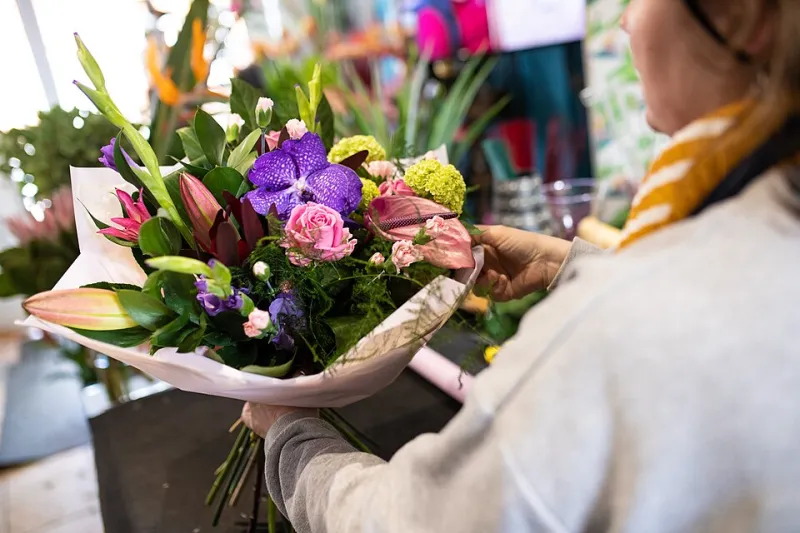
Photo: direct2Florist, CC BY 2.0, via Wikimedia Commons
Walk into a UK florist in November and you will see the usual winter mix: scented narcissi, chrysanthemums, foliage, berries, maybe a few imported roses doing their best. The label on the sleeve might say British-grown, seasonal, locally sourced, or simply nothing at all. It is tempting to treat those words like a food label — a neat set of facts you can trust at a glance. Flowers are not quite that tidy.
This is not a reason to be cynical. It is a reason to be a bit more curious. A good bouquet can come from a glasshouse in Lincolnshire, a field in Cornwall, a Dutch auction, or a Kenyan farm, and every one of those can be a sensible choice depending on the season, budget and what you are trying to do. The trick is knowing what the label is actually claiming, and what it is quietly hoping you will assume.
Why flower labels are a different beast
In the UK, cut flowers do not have the same familiar, mandatory country-of-origin labelling you might expect on a bag of carrots. There is no universal traffic-light system for a bunch of tulips. Some retailers label origin clearly, some use a broad phrase, and some leave the consumer to guess. That means the wording on a bouquet is often a mix of useful information, voluntary disclosure and marketing language.
None of that makes every label dishonest. It just means the label is a starting point, not a certificate. The useful question is not simply 'is this good?' but 'what exactly is this label telling me, and what is it not telling me?'
British-grown: the phrase worth slowing down for
British-grown should mean the flowers were grown in the UK — in soil, under glass or in a polytunnel here — rather than grown abroad and merely assembled here. That is a meaningful distinction. It can support UK growers, shorten some supply chains and give you flowers that are genuinely in step with the British season.
But the phrase is not a single, universal certification. There are grower schemes and certification marks in the UK, and some retailers are very precise, but a sleeve that says British-grown is not automatically proof of every stem. Look for the verb. Grown in Britain is stronger than packed in Britain. Hand-tied in the UK tells you where the bouquet was put together, not where the flowers were raised. Designed in the UK is a creative credit, not an origin label.
If the bouquet is mixed, ask whether every stem is British or only some. A single British foliage stem does not make the whole bunch British-grown, though it might still be a lovely bunch. The useful wording is specific: grown by a named farm, in a named county, with a percentage or a clear list of stems.
Seasonal: whose season?
Seasonal is one of the most elastic words in floristry. In a UK context, it usually suggests flowers that are naturally in season here, which often means a shorter, more local supply chain and better value during peak months. British flowers have a generous run from spring through autumn, with hardy stems and foliage carrying things into winter.
But seasonal can also mean seasonal somewhere else. A rose can be in season in Kenya while it is midwinter in Kent. That does not make it a bad flower; it does make the label less useful if you were hoping to buy in step with the British growing year. In mid-November, a bouquet stuffed with British dahlias and sweet peas should raise a gentle eyebrow. A bunch of British chrysanthemums, foliage and berries makes far more sense.
The honest version of seasonal is usually seasonal and British, or seasonal in the country of origin. If a label just says seasonal, ask which season and where. It is a fair question, and a good florist will not mind it.
Locally sourced: local to whom?
Locally sourced sounds warm and specific. In practice, local can mean grown within a few miles, bought from a regional wholesaler, or sourced from a UK distribution centre that happens to be nearby. Those are three very different claims.
If local matters to you, ask for the radius or the grower. A florist who buys from a farm down the road will usually be pleased to say so. A supermarket bouquet labelled locally sourced may simply mean it was packed or distributed locally. That is not a scandal, but it is not the same as a field down the lane.
Country of origin: read the whole line
Country-of-origin wording is often the most concrete information on a bouquet, especially online or on a wholesale box. Look for the full phrase: grown in Kenya, product of the Netherlands, origin: Ecuador. The small print matters. Origin: UK, Netherlands and Kenya means a mixed bunch. It is not a British bouquet with a few guests; it is a blend.
If the label lists several countries, treat it as an invitation to ask which stems come from where. You may not need to know every detail, but if you are buying for a reason — supporting British growers, reducing air miles, buying within a budget — the answer should match the reason.
The grey areas that deserve a raised eyebrow
Some phrases are not origin labels at all. British-style, countryside-inspired, farm-fresh and eco-friendly can all be perfectly honest descriptions of a design or a business, but they do not tell you where the flowers were grown. A photo of a British meadow on the packaging is not a location. Neither is a name that sounds like a county.
Environmental certifications are also worth reading carefully. A scheme may cover farming practices, water use or worker welfare without making any claim about UK origin. That does not make it meaningless; it just means it is answering a different question. Do not let a green logo stand in for a country of origin.
A simple label-checking routine
First, decide what you actually care about. Is it British-grown stems, a local florist, lower air miles, a specific colour, or a fixed budget? You cannot optimise for everything, and a label that is vague on origin may still be clear on freshness or price.
Second, read the verb. Grown in is stronger than packed in, assembled in, designed in or hand-tied in. Third, look for a named grower, farm or county. Specificity is usually a good sign, not because vague sellers are villains, but because specifics are harder to fake and easier to verify.
Fourth, check the season. If the label claims British-grown and the bouquet is full of out-of-season stems, ask how. Heated glasshouses exist, but they change the cost and the environmental story. Fifth, ask directly: which stems are British, what percentage of the bunch is UK-grown, and where were the rest grown? A good florist will give you a straight answer, even if it is not the answer you hoped for.
What to do when the label is vague
If the label is vague and the shop cannot tell you more, you have a few sensible options. Buy a single-variety British bunch in season, where origin is easier to pin down. Choose a florist who names their growers. Or accept an imported bouquet with clear origin labelling and a fair price, rather than paying a premium for wording that only sounds local.
There is no shame in buying imported flowers. The UK flower trade has relied on them for decades, and they keep colour and choice on the table in winter. The shame would be paying extra for a story that the label cannot back up.
The honest bouquet
A good bouquet label should do the same job as a good florist: tell you what you are getting, without making you feel foolish for asking. In 2026, the best UK flower labels are not necessarily the longest or the greenest. They are the ones that use plain words precisely — grown here, bred there, packed here, mixed origins, in season now.
So next time you pick up a bunch, give the label ten seconds of proper attention. Read the verb, check the country, notice the season, and ask one clear question if something does not add up. You do not need to become a supply-chain detective to buy flowers well. You just need to know when a word is doing honest work, and when it is only there to make the bouquet sound like it grew up down the road.