The Card Carries the Bunch: Writing Flower Messages That Land
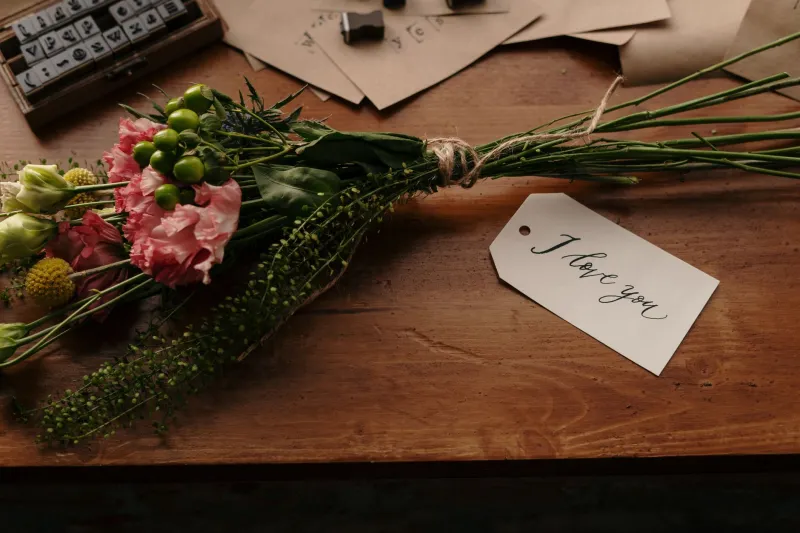
Flowers arrive first. The card arrives second. But in practice, the card is often what people remember, read twice and tuck into a drawer. It is also the bit most of us agonise over while standing at the kitchen counter with a tiny florist's card and a pen that suddenly feels enormous.
The good news is that you do not need to be poetic. You need to be clear, warm and brief. Think of the card as the label on a very good bottle of wine: it should tell the recipient what they are holding, not tell them the entire history of the vineyard.
Start with the feeling, not the flowers
Before you write a word, decide what the bunch is actually for. Is it congratulations, comfort, thanks, apology or simple affection? Most flower cards go wrong because they try to do three of those things at once and end up doing none of them properly.
A useful rule is one feeling per card. If you are sending flowers for a new baby, lead with joy. If you are sending them after a bereavement, lead with steadiness. If you are sending them because you forgot a birthday, lead with honesty and skip the elaborate excuses. The flowers are already doing the visual work; the card only needs to say the emotional thing plainly.
Match the length to the occasion
Short is usually better, but not always. Here is a rough guide for UK flower gifts.
Birthdays: two or three lines is plenty. Use the person's name, say something warm, and add a small specific detail if you can. "Happy birthday, Ellie — hope today is slow in the best way. Love, Sam" beats a generic verse every time.
Anniversaries: slightly warmer, slightly more personal. One shared memory or private joke is worth more than five lines of formal sentiment.
New baby: keep it light and practical. "Congratulations to you three. He is gorgeous. We are bringing dinner next week — no arguments." That last sentence matters more than any flower symbolism.
Thank-yous: be specific. "Thank you for the lift to the station on Saturday" is far better than "thank you for everything". Specific thanks feel genuine; vague thanks feel like a template.
Sympathy: simple and steady. "Thinking of you all. No need to reply." That final phrase is a small kindness. Avoid trying to explain the loss or fill the silence.
Apologies need fewer words, not more
Apology cards are where people over-write. You do not need a paragraph of context, a list of reasons or a promise that you will "make it up to them". A flower card is not the place for a full mediation.
Try something like: "I am really sorry about Saturday. I got it wrong. These are for you. No need to ring me back today." That does four useful things: it names the issue, owns it, offers the flowers and removes pressure. If the situation is serious, send the flowers with a short note and follow up properly in person or by phone. The card should open the door, not deliver the whole speech.
A short note can still feel personal
The trick is specificity. A single detail does more work than three adjectives. "Hope the new job is less chaotic than the last one" is personal. "Wishing you all the best in your new role" is a card-shop default.
If you are stuck, use this three-part shape:
- Their name.
- One clear wish, thank-you or acknowledgement.
- A warm sign-off.
That is it. "Rachel — hope this week is kinder than last. Love, Priya." It is short, but it sounds like a person rather than a greetings-card algorithm.
Mind the tiny card and the UK weather
Florist cards are small. Online delivery cards can be even smaller. Do not try to fit an essay into a space the size of a bus ticket. Write the main message first, then add the sign-off. If you run out of room, stop. A cramped card with six crossed-out lines looks like a ransom note.
Use a fine-tipped pen if you have one, especially on glossy card. Pencil smudges; fountain pen can bleed. And if the flowers are travelling by post or courier, check that the card is securely attached. A beautiful message floating loose in a box is a small tragedy.
Also, avoid writing anything on the outside of the envelope that you would not want a neighbour, courier or receptionist to read. Surprises are lovely; accidental public announcements are not.
What to leave out
Skip the guilt. "Sorry these are late" can be said once, lightly, but do not turn the card into an apology for the apology. Skip heavy symbolism unless you genuinely know the person's taste. Not everyone wants to be told that lilies represent purity, and some people will just wonder why you sent lilies.
Avoid jokes about money, death, divorce or the recipient's age unless you are absolutely certain of the relationship. And do not sign off with "love" if you would not say it out loud. "Best wishes" is perfectly warm when it is honest; forced intimacy is worse than mild formality.
The final test
Read the card back in your own voice. Does it sound like something you would actually say to the person? If not, simplify it. The best flower cards are not the most eloquent ones. They are the ones that feel like a hand on the shoulder, a quick smile or a quiet "I remembered".
Flowers are the gesture. The card is the sentence that makes it land. Keep it clear, keep it kind, and do not be afraid of five good words.